Session 03 · Junior School

Assessment, AI and hardthinking.


The AI Assessment Scale and the Decision Pause as a shared language with colleagues and students. Then a workshop to redesign an existing task.

  • Duration 90 minutes
  • Platforms Gemini · NotebookLM · Magic AI · Century · Magic Student

Linking back

The Junior question.

AI has separated the ability to produce work from the ability to evaluate it. Students produce better-looking work while learning less. How do we structure AI use so students still do the cognitive work?

Two GTT D4 elements do most of the work here:

  • 4.5 Embedding. Learning must be practised until fluent. AI bypasses retrieval if we let it.
  • 4.6 Activating. Students plan, monitor, and evaluate their own learning. The Decision Pause is a two-minute habit from Year 3 upward.

Great Teaching Toolkit · Dimension 4.5

Embedding: getting the learning to stick.

Memory is not just a storage facility. The schemas we use to organise knowledge are the very things we think with — which is why retrieval, not recognition, is the learning.

Practice until fluent, automatic, secure. Knowledge needed for future learning has to be readily retrievable. Forgetting is normal — slowed by periodic revisiting and tightened by deliberate practice.

Where AI gets in the way. If a student offloads retrieval to a chatbot, the schema never forms. They recognise the answer when they see it, but cannot generate it without the prompt. Recognition without retrieval looks like learning, but isn't.

Coe et al. (2020), citing Sweller (1994). The four practices opposite are drawn from the cognitive-science evidence summarised in the GTT review.

Overlearning

Continue practising past the point of correct performance — durability comes from going further. (Soderstrom & Bjork, 2015)

Spacing & the testing effect

Distributed practice with deliberate gaps; low-stakes retrieval is the most effective way to build long-term recall. (Adesope et al., 2017; Bjork & Bjork, 2011)

Desirable difficulty

Practice that feels harder produces stronger learning — the surface-level struggle is the point.

Interleaving & elaboration

Varying conditions, mixing topics, asking students to explain — all strengthen connections between schemas.

A shared language

The AI Assessment Scale.

A scale, not a hierarchy. Different tasks need different levels. Y3–Y4 sits mostly at Levels 1–2 to protect retrieval; Y5–Y6 begins exploring Levels 2–3 with structured support.
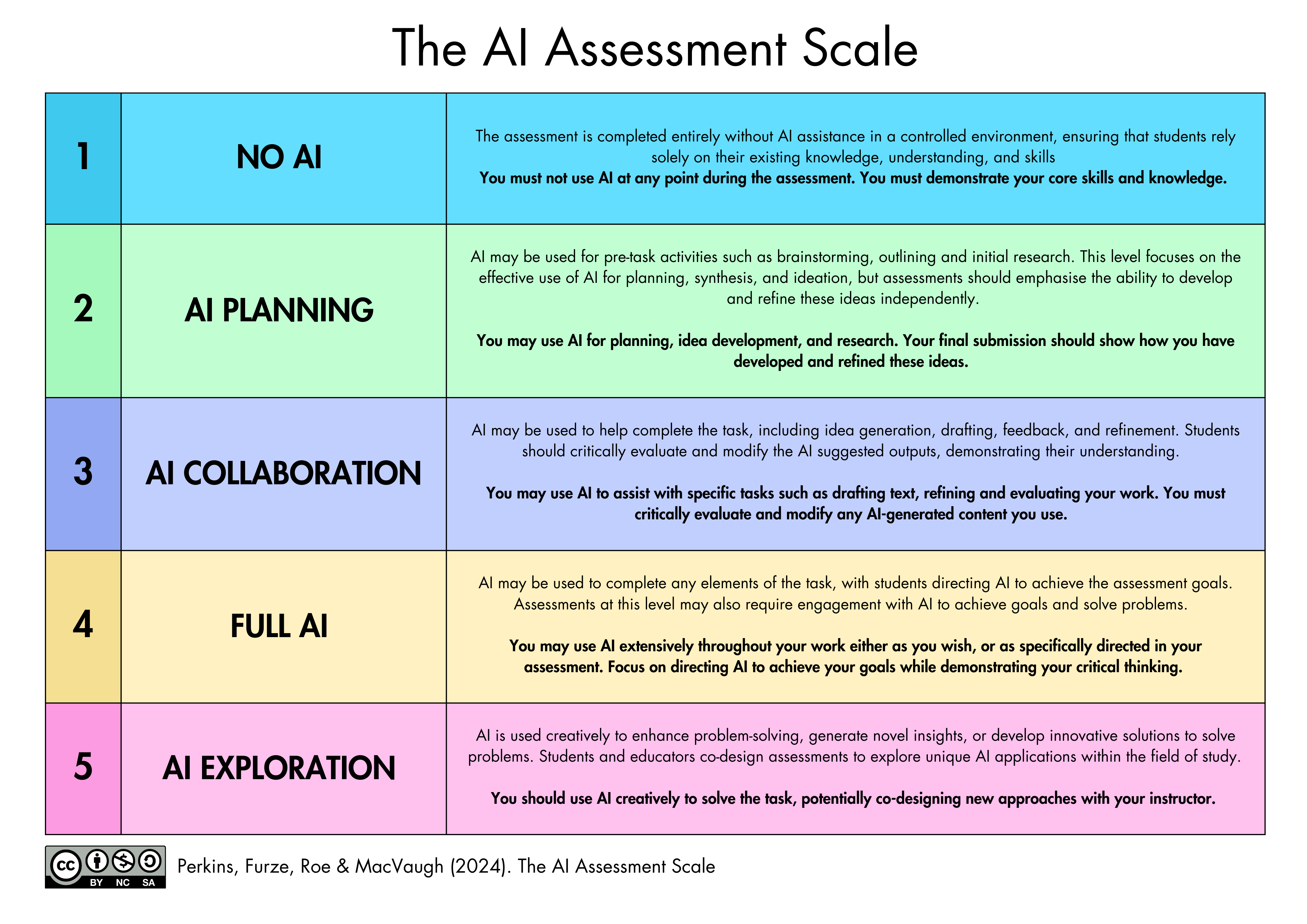
The AI Assessment Scale — five levels from No AI through to Full AI integration.
aiassessmentscale.com

A two-minute habit

The Decision Pause.

Four questions before any AI-assisted task. From Year 3 upward; for younger students, simplified to a single prompt: "Is this something I should figure out myself first?"

  1. What do I already know about this?
  2. What feels hard — and is that hardness useful?
  3. If I use AI right now, what thinking will I skip?
  4. My decision: I will / will not use AI for ___ because ___.

GTT 4.6 (Activating) in two minutes. Connects to the metacognitive language being introduced through Digital Thinking Frames.

The workshop

Redesign one of your assessments.

Bring an existing task. In groups, work through three questions in order — don't move on until you can answer the previous one with conviction.

Question 1

Where should AI be kept out?

Where is the intrinsic cognitive work? Which D4 elements does the task target? If the target is 4.5 (Embedding) — fluency through retrieval — AI almost always degrades the learning.

Question 2

Where can AI add genuine value?

Where does AI extend thinking beyond what is possible alone? Stretch, not shortcut. Sparring partner, counter-example generator, exemplar producer — each one pulls a different D4 element into focus.

Question 3

Where can AI make your life easier?

Resource creation, feedback at the task level, admin. Beneficial offloading of the extraneous load that doesn't belong in your week. AI handles task-level corrections; your judgement is irreplaceable for process-level feedback.

Reference card

GTT D4 — what your task targets.

The element your task primarily targets drives the AIAS level you choose.

4.1 Structuring
Sequencing, scaffolding, fading. A well-sequenced task makes the right learning the easiest path.
4.2 Explaining
Schemas, prior knowledge, examples. Building connections that stick.
4.3 Questioning
Promoting and assessing deep, evaluative thinking.
4.4 Interacting
Bidirectional, responsive feedback. The expert eye.
4.5 Embedding
Retrieval, spacing, interleaving. Making knowledge fluent. Often where AI should be kept out.
4.6 Activating
Metacognition, self-regulation, independence. Where the Decision Pause lives.

Takeaways

What to walk out with.

  • The AIAS as a shared language with colleagues and students.
  • The Decision Pause as a two-minute routine for any task from Year 3.
  • "Which D4 element am I targeting?" as the question that drives where AI fits.
  • Task-level feedback to AI; process-level feedback stays with you.
  • Prompting as conversation, not formula.