Step 01
Capture
Files, docs, PDFs, voice transcripts from meetings, photographed handwritten notes. Multimodal in.
Session 04 · Senior School
When students should stop using AI, the kind of feedback only humans can offer, and a follow-along build of one Gemini Gem from your own materials.
The metacognition problem
GTT 4.6 — activating self-regulated learners — asks teachers to help students plan, regulate and monitor their own learning. The expertise reversal effect (Sweller et al., 2019): scaffolding that helps novices becomes counterproductive for experts.
AI scaffolding never comes down. It's always there.
The skill is recognising the moment scaffolding stops being helpful and becomes a substitute for thinking.
The four feedback levels
Hattie & Timperley (2007) identified four levels. AI feedback overwhelmingly operates at the bottom two — task and self.
Corbin, Tai & Flenady (2025): recognitive vs. extra-recognitive feedback. Recognitive feedback is grounded in mutual recognition; both teacher and student are vulnerable to judgement, and the trust that develops is what makes feedback transformative. Extra-recognitive feedback addresses the work, not the person — technically accurate, relationally empty. AI feedback is structurally extra-recognitive.
The move: let AI handle task-level feedback so your time goes to the recognitive conversations only humans can have.
Student feedback-seeking
Zhan, Boud, Dawson & Yan (2025): the gap between low- and high-feedback-literacy students using the same AI tool.
Low feedback literacy
"Explain photosynthesis to me."
Vague prompt → generic response → passive acceptance.
High feedback literacy
"I think the light-dependent reactions produce ATP and NADPH, but I'm not sure how the electron transport chain fits in. Can you ask me questions to test whether I understand the sequence?"
Specific prompt against criteria → AI as Socratic partner → monitored revision.
The second prompt is teachable. It is also assessable — the prompt itself becomes evidence of metacognitive engagement.
Designing the assessment
Cycle through levels rather than pick one. Students can't game a process that moves in and out of AI; each phase generates evidence of authentic engagement.
For IB contexts: declaration and authentication happen at every stage, not just at submission. Detection is a dead end — design is the answer.
The follow-along workflow
Process-based thinking, not app-based. The same three-step pattern works in Gemini Gems, Custom GPTs, and Copilot Agents — pick the ecosystem your school is already in.
Step 01
Files, docs, PDFs, voice transcripts from meetings, photographed handwritten notes. Multimodal in.
Step 02
Pair captured material with school documentation: syllabi, assessment policies, marking criteria, department handbooks.
Step 03
Build a custom system — Gemini Gems, Custom GPTs, Copilot Agents. Every interaction starts from a shared foundation, not a blank prompt.
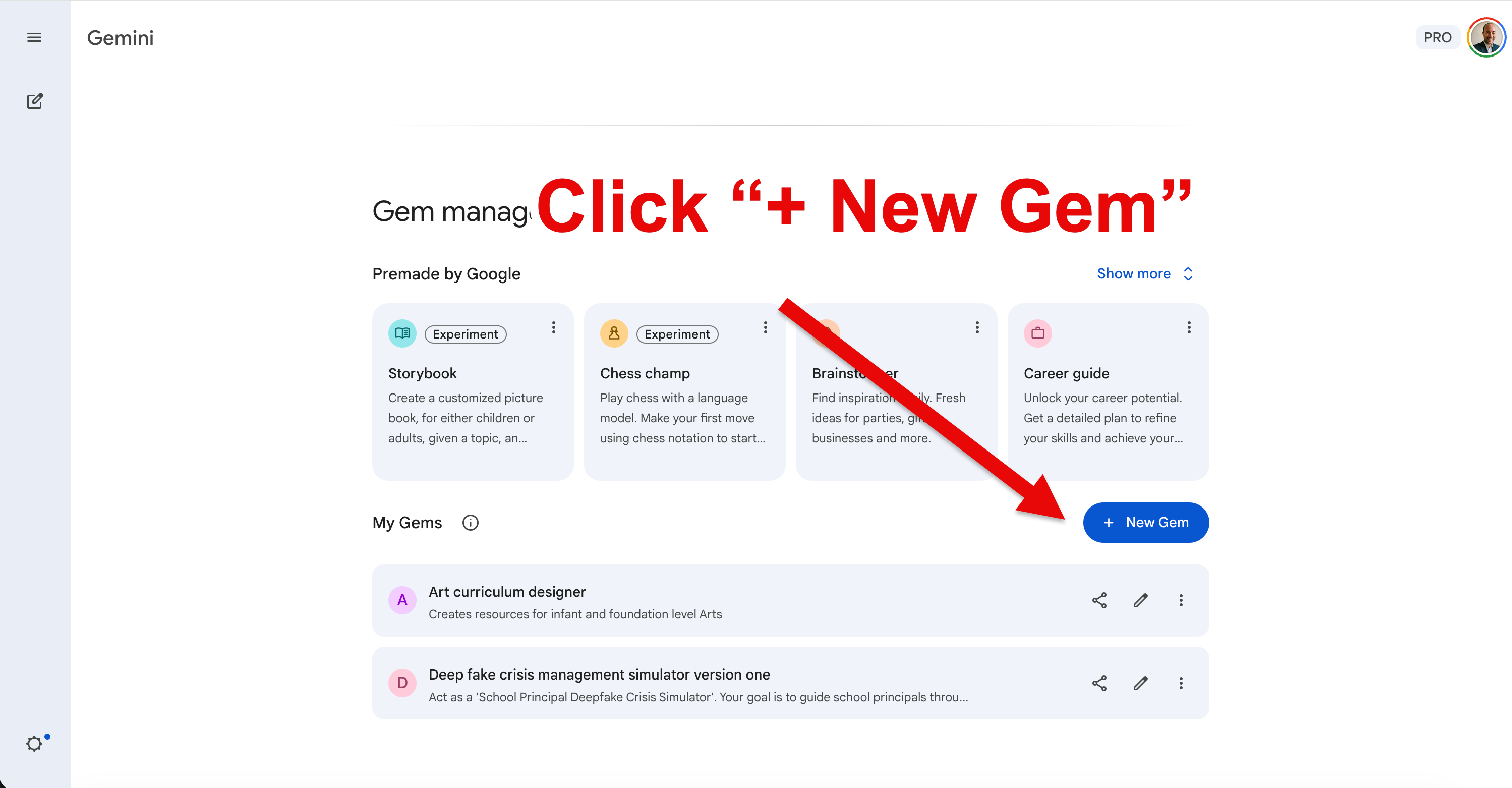
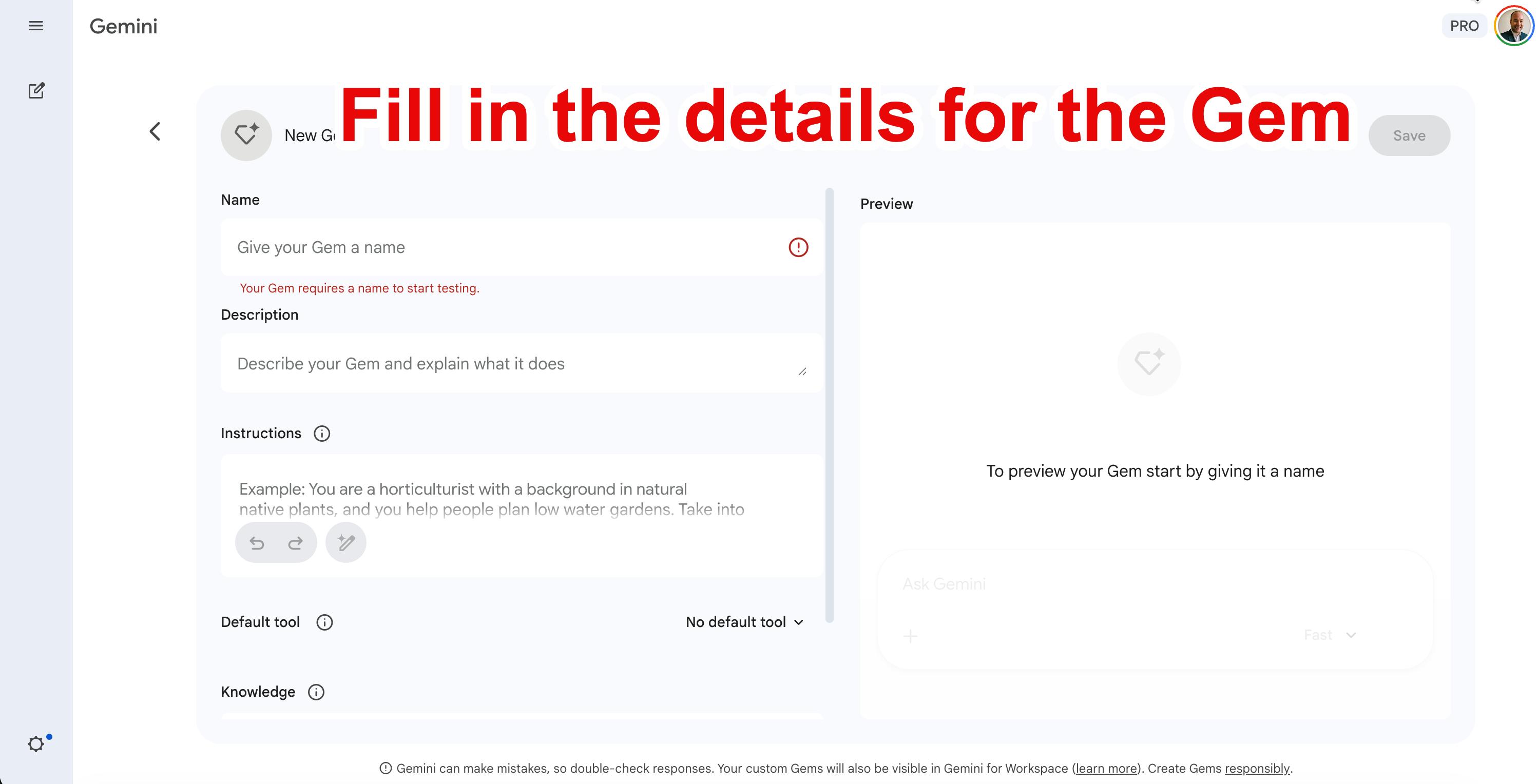
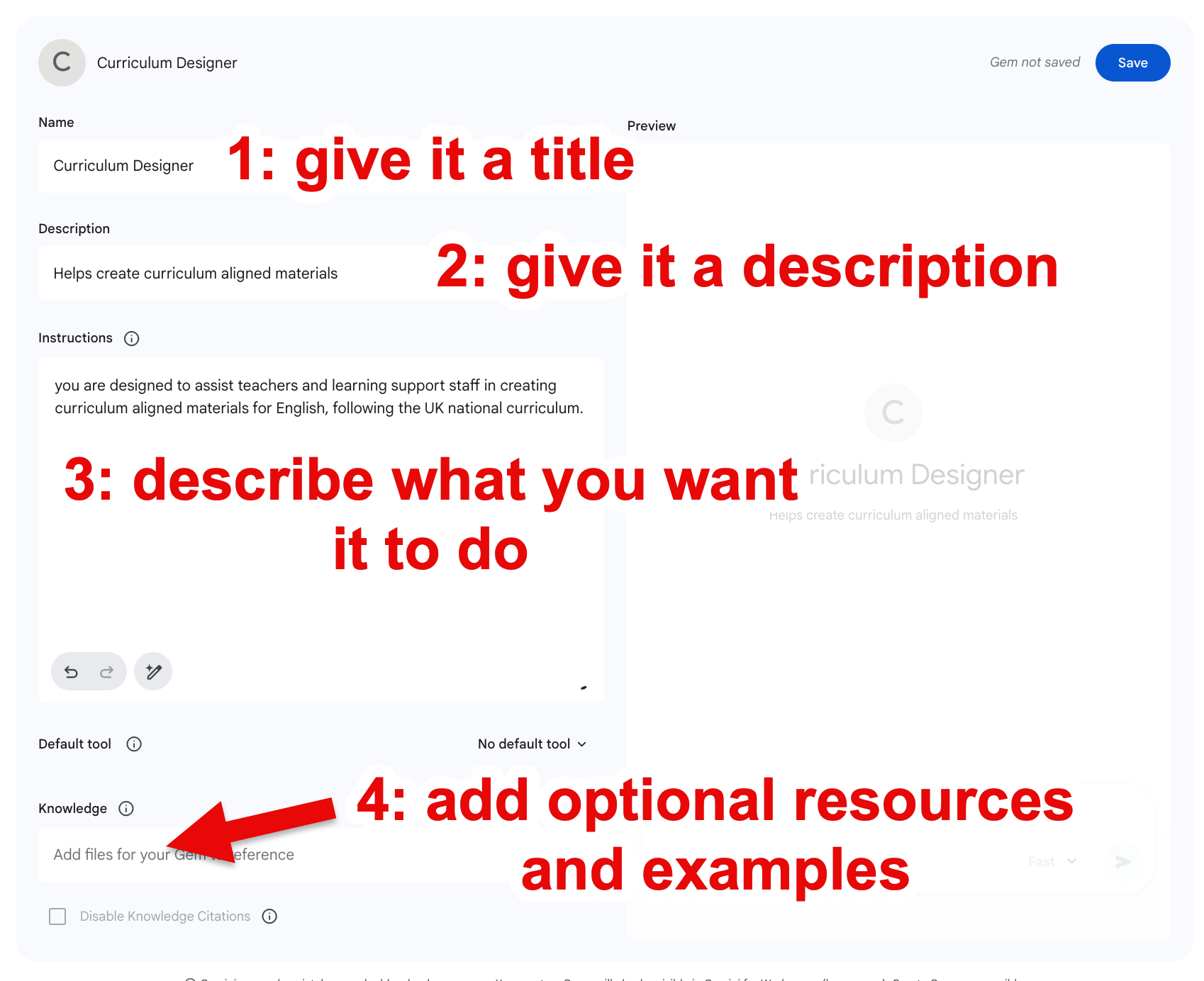
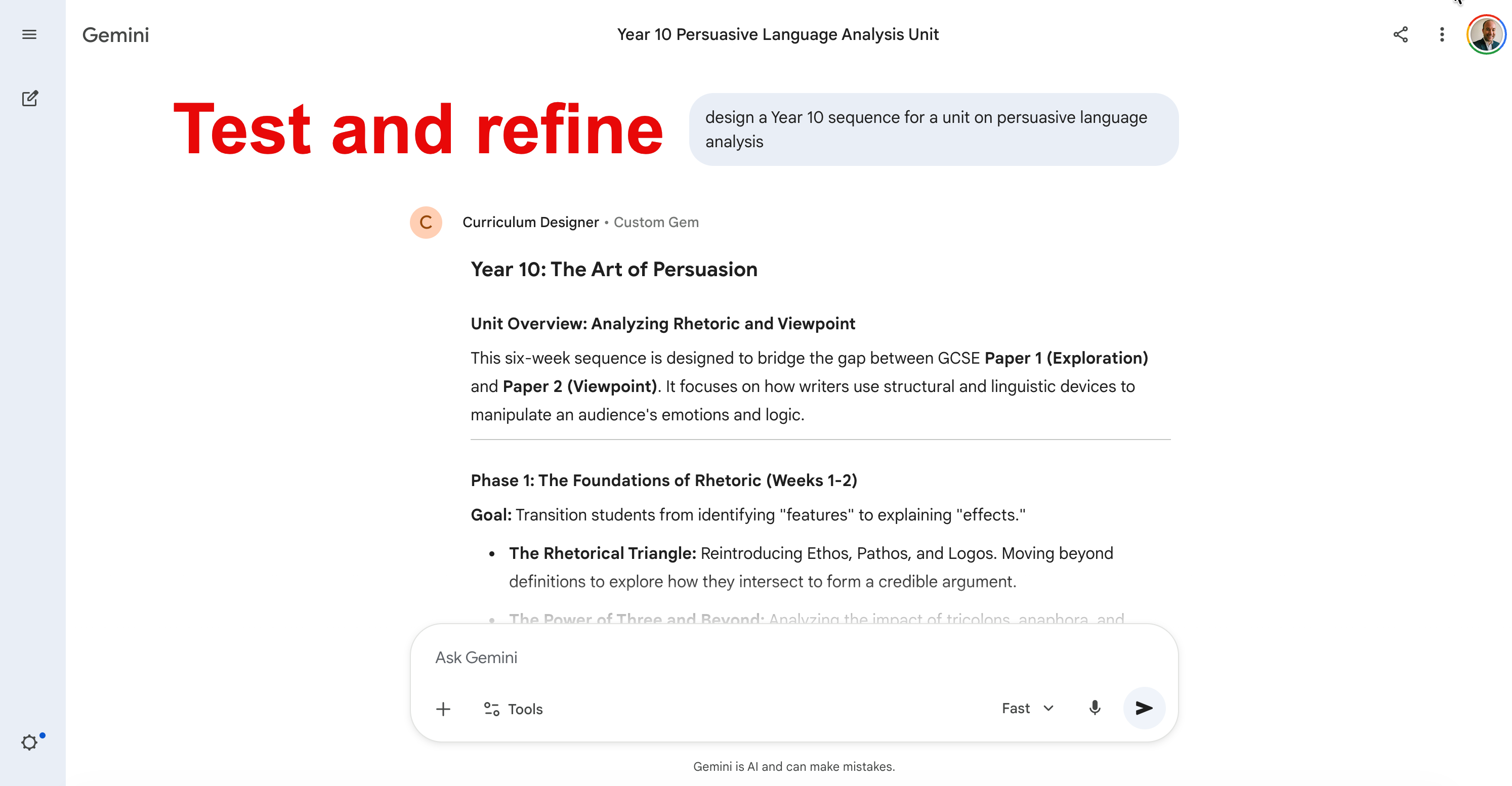
Walkthrough — building a Gemini Gem
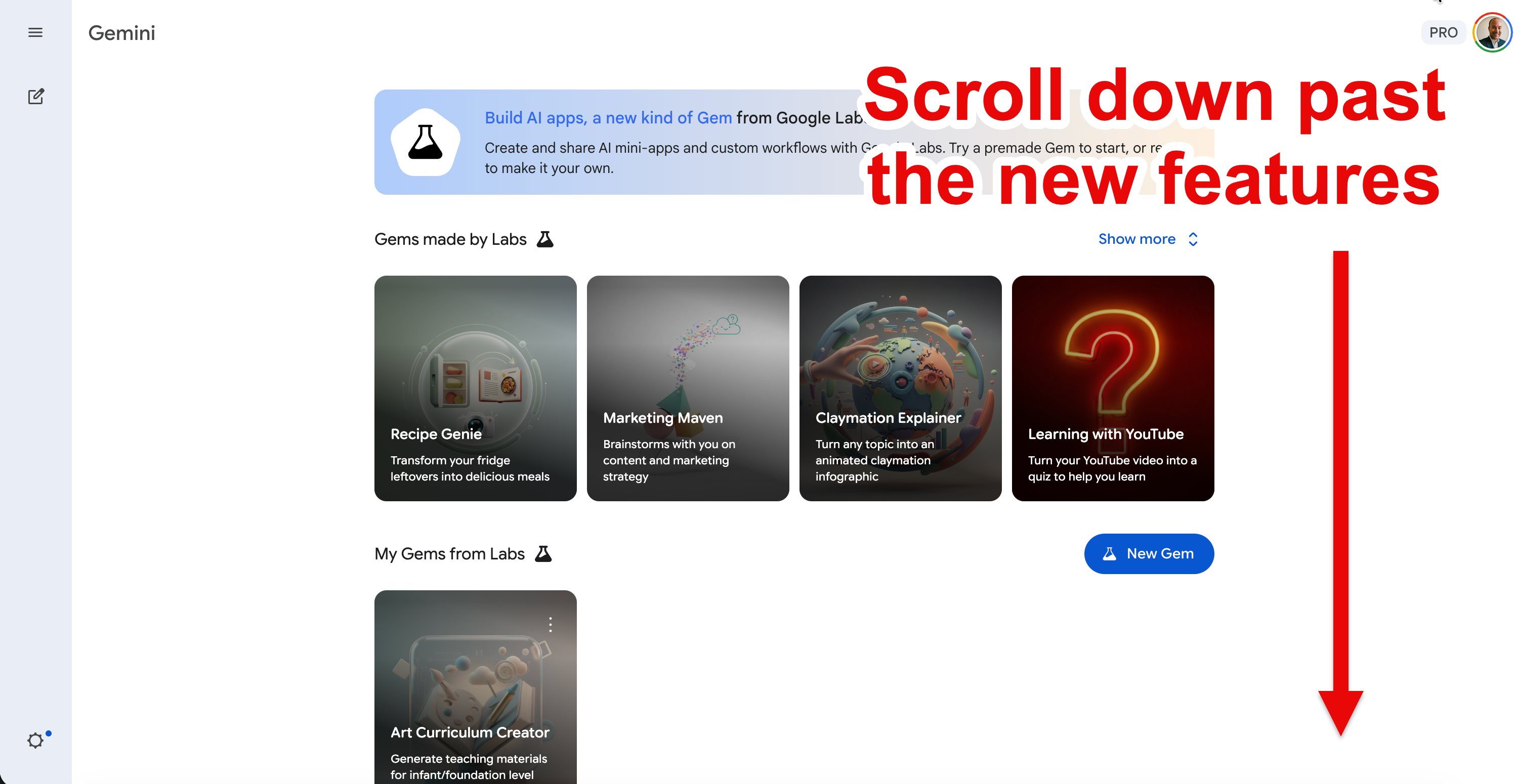
Step 01
From the Gemini home screen, scroll past the new features and Gems made by Labs to reach the Gem manager.
Bringing it together
Maps onto GTT D4: Structuring protects expertise, Questioning develops evaluation, Activating builds metacognition.